A home juice delivery business can begin with a single cooler, a smart menu, and a handful of people who want better wellness habits without another stop on their calendar. But turning fresh juice into dependable income requires more than great recipes. You need a focused offer, disciplined production, compliant operations, and a reason for clients to choose you over the grocery store juice aisle.
This is where passionate wellness entrepreneurs separate themselves from hobbyists. You are not simply selling bottles. You are creating a convenient, high-touch wellness experience that can build recurring revenue, visibility, and real authority in your local market.
Start Your Home Juice Delivery Business With a Clear Niche
Trying to serve everyone usually leads to a menu that is too large, a message that is too vague, and margins that disappear fast. Your first job is to decide who your delivery service is built for.
You might serve busy professionals who want a weekly fridge reset, fitness clients looking for post-workout freshness, parents seeking convenient plant-forward options, or workplace teams that want a wellness perk. A niche does not limit your potential. It gives people a fast answer to the question, “Why should I buy from you?”
Your positioning should be more meaningful than “cold-pressed juice delivered.” Consider the transformation and convenience behind the bottle. Perhaps you offer a weekly juice ritual for high-performing women, a guided green juice starter series, or fresh office delivery for teams that want to make healthier choices easier.
Be careful with health claims. You can educate customers about ingredients, hydration, and general wellness support, but claims that your juice treats, cures, or prevents disease can create legal and ethical problems. Build trust through ingredient transparency, sound wellness education, and a clear understanding of your scope of practice.
Build an Offer People Can Buy Again and Again
One-off bottle sales can introduce people to your brand, but subscriptions create the foundation of a sustainable business. Delivery has fixed costs: produce shopping, prep, bottling, labeling, route planning, fuel, refrigeration, and your time. Recurring orders make those costs easier to forecast.
Start with a tight menu of four to six juices. Include a familiar green option, a bright citrus-forward option, a root-based juice, and one seasonal feature. A smaller menu means less produce waste, cleaner prep systems, and easier quality control. It also helps customers remember their favorites.
Package the menu into simple choices rather than asking every buyer to build a custom order. For example, offer a six-bottle weekly box, a 12-bottle household box, and a workplace case. Customization can come later, once you understand demand and your systems are stable.
Pricing must reflect the whole business, not just the cost of apples and celery. Calculate your ingredient cost per bottle, packaging, labels, labor, delivery expenses, payment processing, kitchen fees, taxes, and a realistic allowance for waste. Then price for profit. If the numbers only work when you pay yourself nothing, the business is not ready to scale.
A useful target is to keep your menu simple enough that customers can decide in under a minute. Your marketing should make the next step equally easy: choose a plan, select a delivery day, and place the order before the weekly cutoff.
Treat Food Safety and Compliance as Your Foundation
Fresh juice is perishable. That fact should shape every decision you make, from your delivery radius to your production schedule. Before selling a single bottle, contact your city or county health department and your state food regulatory agency. Home-based food rules vary widely, and many cottage food laws do not permit refrigerated juice production or direct delivery from a residential kitchen.
You may need to use a licensed commercial kitchen, obtain permits, carry business insurance, follow labeling requirements, and meet specific refrigeration and sanitation standards. If you are using a commercial juicer or cold-press system, learn the requirements that apply to your process and location. Do not assume that selling at a farmers market and delivering to homes are regulated the same way.
Your label should clearly identify the product, ingredients, allergens where applicable, net quantity, business information, storage instructions, and any disclosures required in your jurisdiction. Establish written procedures for washing produce, sanitizing equipment, storing ingredients, bottling, recording production dates, and handling customer complaints.
This may feel less glamorous than creating a beautiful juice brand. It is also what protects your customers, your reputation, and the future of your business. Professionalism is part of the product.
Create Delivery Routes That Protect Your Margin
A delivery business can lose money quickly when orders are scattered across a large geographic area. The answer is not to drive farther for every request. The answer is to create zones.
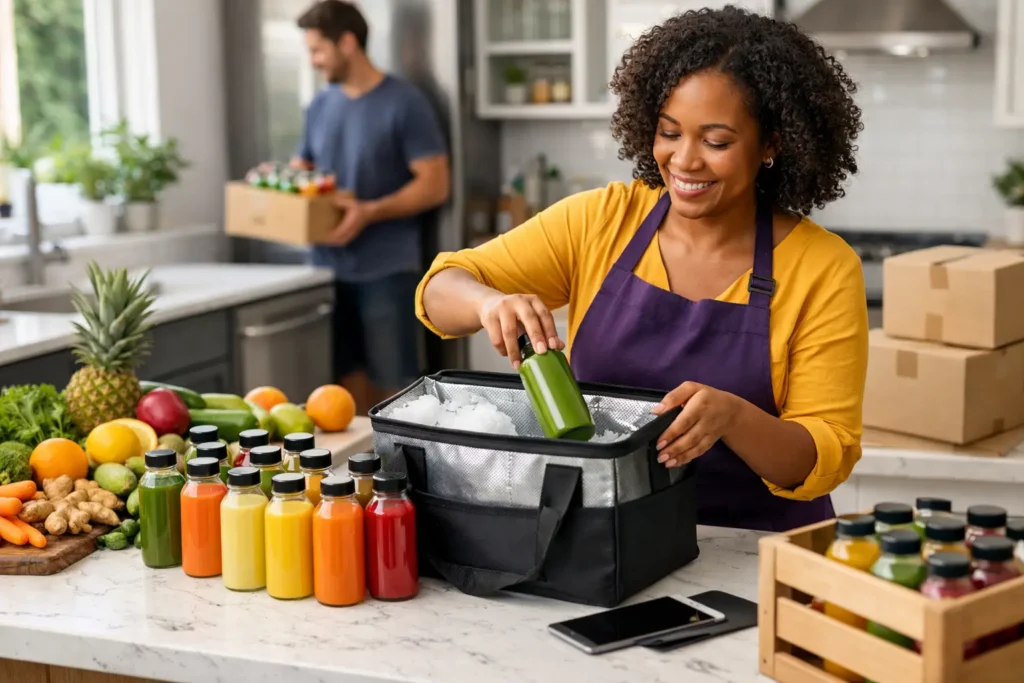
Choose one or two neighborhoods or ZIP codes for your first launch. Set specific delivery days and establish an order minimum. Customers are usually happy to work within a schedule when the experience is clear and reliable. You can use insulated bags, ice packs, and a delivery confirmation system to help maintain product quality and customer confidence.
As demand grows, expand route by route rather than chasing single orders across town. A dense route with 20 customers can be far more profitable than 20 customers spread over an entire county. Consider drop points at yoga studios, coworking spaces, apartment buildings, or offices when local regulations and partnerships allow it. One stop that serves multiple customers can dramatically improve your delivery economics.
Keep a close eye on three numbers: average order value, repeat purchase rate, and delivery cost per order. These tell you more about the health of your company than social media likes ever will.
Make Your Brand Feel Like a Wellness Movement
People may buy their first box because they like your flavors. They keep buying because your brand helps them feel supported, seen, and committed to the person they want to become.
Show the real story behind your business. Share produce prep days, your ingredient choices, customer routines, and practical juicing education. Teach clients how to enjoy their delivery, how to store it, and how to turn a juice subscription into a weekly ritual. Your content should answer common questions before they become barriers to purchase.
This is also where specialized knowledge creates an advantage. A general wellness coach can talk about healthy habits. A trained juice professional can communicate with greater confidence about ingredient combinations, thoughtful protocols within appropriate scope, and how juicing fits into a broader wellness lifestyle. Juice Guru Institute trains entrepreneurs to combine juice therapy education with business-building strategy, helping them develop a clearer niche in a crowded wellness market.
Do not hide behind a logo. Be the face, voice, and guide of your brand. Host a local tasting, offer a short virtual class, speak at a fitness studio, or create a simple new-customer challenge. Every educational touchpoint can turn a curious follower into a recurring client.
Grow Beyond Bottles Without Losing Focus
Once your weekly delivery operation is consistent, your business can develop multiple income paths around the same expertise. The strongest additions are the ones that serve your existing customers rather than distracting you from them.
You might add seasonal cleanses, corporate wellness delivery, juice-making workshops, private pantry consultations, events, or digital guides. Each can increase customer lifetime value and position you as more than a delivery provider. Still, expand in stages. A new offer should solve a clear client need and use systems you already have.
Resist the temptation to launch every idea at once. First, prove that your core offer is profitable, safe, and repeatable. Then build the next revenue stream from that stable base. That is how a small local operation becomes a recognizable juicing brand with influence beyond one delivery route.
Your first customers do not need a giant company. They need someone who makes fresh, thoughtfully prepared juice easier to enjoy and who shows up when promised. Build that trust bottle by bottle, and your home juice delivery business can become a powerful first chapter in the Juice Revolution.