A glass of juice is simple. Guiding another person toward thoughtful, sustainable wellness practices is not. A serious juicing curriculum guide should prepare aspiring professionals for far more than ingredient combinations or attractive recipes. It should develop judgment, communication skills, ethical boundaries, and a clear understanding of how therapeutic juicing can fit within a broader, balanced wellness lifestyle.
For health coaches, holistic practitioners, entrepreneurs, and career changers, specialization creates distinction. But specialization without structured education can leave even the most passionate practitioner unsure of what to say, how to support clients responsibly, or how to translate knowledge into a viable service. The right curriculum turns interest into professional capability.
What a Professional Juicing Curriculum Should Accomplish
A professional curriculum is not a recipe collection arranged into modules. It is a sequence of learning experiences that helps students understand why certain choices may be appropriate, how to communicate about them responsibly, and when a client’s needs fall outside their scope of practice.
The strongest programs connect foundational knowledge with real-world application. Students need the science-informed context behind whole-food nutrition and juicing, but they also need practice listening to goals, asking useful non-medical questions, designing realistic routines, and helping people make changes they can maintain.
This matters because clients do not live in a classroom. They have budgets, families, work schedules, food preferences, access challenges, and varying levels of confidence in the kitchen. A trained juice professional learns to meet people where they are rather than prescribing a one-size-fits-all approach.
A meaningful curriculum should also reinforce a central professional principle: therapeutic juicing is a supportive wellness practice, not a substitute for individualized medical care, a balanced diet, or guidance from licensed healthcare providers. Clear scope and ethical communication protect clients and strengthen the credibility of the field.
The Core Subjects in a Juicing Curriculum Guide
Foundations of Whole-Food Nutrition and Juicing
Students need a practical grasp of plant foods, juice preparation methods, flavor balance, food quality, and the differences between juicing and blending. They should understand how ingredient selection can affect taste, texture, yield, cost, and a client’s willingness to continue a routine.
Education should move beyond simplistic claims about “good” and “bad” foods. Instead, it should explore how vegetables, fruits, herbs, and other whole-food ingredients can be incorporated thoughtfully into everyday wellness routines. This approach supports informed choices without overstating what juice can do.
Preparation standards belong here as well. Safe produce handling, equipment hygiene, storage considerations, and realistic guidance on freshness are essential professional skills. A beautiful juice is not enough if the practitioner cannot teach clients how to prepare it safely and consistently.
Therapeutic Juicing Applications Within Scope
Therapeutic juicing education should focus on wellness goals, lifestyle context, and responsible support. Students can learn frameworks for creating juices that align with general objectives such as increasing vegetable variety, building a morning routine, supporting hydration habits, or making nourishing foods more approachable.
The distinction between education and medical advice must remain clear. A qualified juice professional can educate, coach, and encourage clients around food-based wellness practices. They should not diagnose conditions, promise outcomes, alter prescribed care, or position themselves as a replacement for a licensed clinician.
This is where professional confidence becomes especially valuable. Confidence is not claiming certainty where none exists. It is knowing how to explain options clearly, use appropriate language, document client goals, and refer out when a concern requires medical expertise.
Coaching and Client Communication
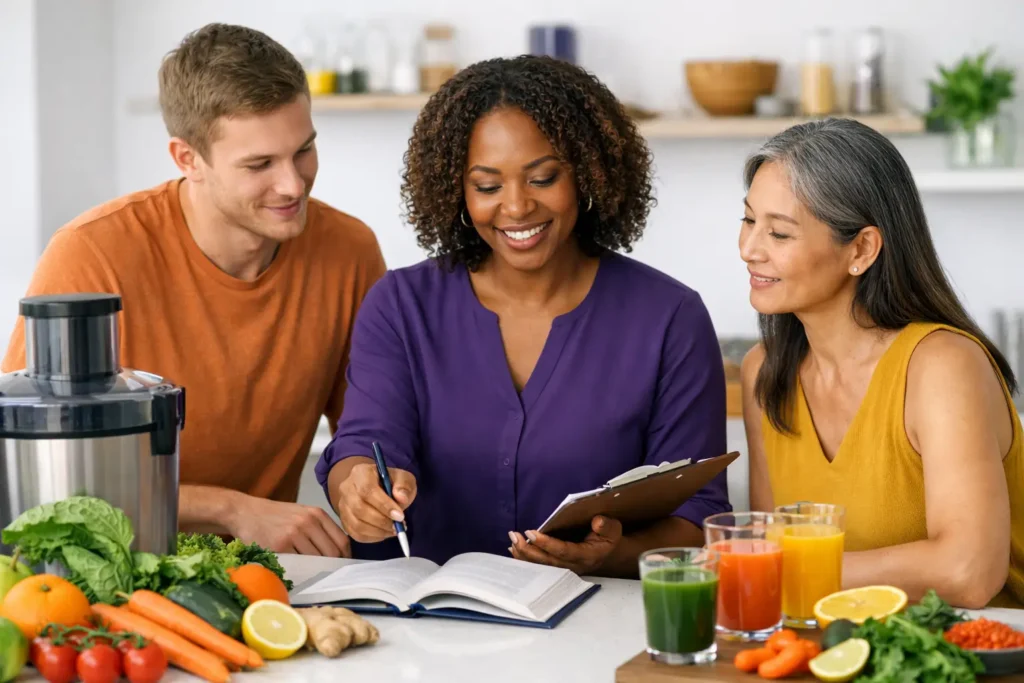
Knowledge has limited value if it cannot be communicated with care. A curriculum should teach students how to conduct an intake within their scope, establish goals, identify barriers, and create realistic next steps with clients.
Effective coaching is collaborative. Rather than telling a client to overhaul every habit at once, a skilled practitioner may help them choose one attainable action: preparing ingredients the night before, replacing one routine beverage with a vegetable-forward juice, or learning two dependable recipes they genuinely enjoy.
Students should also practice motivational communication. Clients are more likely to follow through when they feel heard, not judged. The goal is to offer structure and encouragement while respecting autonomy, culture, preferences, and readiness for change.
Ethics, Safety, and Professional Boundaries
Ethics should not be an afterthought at the end of a program. It should be woven through every lesson. Professionals need clear standards for advertising, testimonials, privacy, informed consent, record keeping, referrals, and language around wellness outcomes.
Responsible marketing is particularly important in a field where bold health claims can travel quickly online. A credible practitioner avoids guarantees, sensational promises, and disease-related claims. They communicate the value of education and support without creating false expectations.
Professional boundaries also make a practice more trustworthy. Students should know when to pause, ask a client to consult an appropriate healthcare professional, or collaborate with other members of a client’s wellness support system. This is not a limitation. It is what ethical leadership looks like.
Business Skills for a Sustainable Practice
Many aspiring juice professionals want to make an impact, but they also need a practical path to building meaningful work. A curriculum that ignores business leaves graduates with knowledge but no clear way to use it.
Business training can include defining a niche, creating service packages, setting professional policies, leading workshops, developing educational materials, and communicating a clear value proposition. A wellness professional may choose to offer one-on-one coaching, group education, workplace wellness sessions, community classes, or support alongside an existing yoga, fitness, nutrition education, or juice bar business.
The right business model depends on the practitioner. Someone with an established audience may begin with workshops, while a career changer may benefit from a focused coaching offer and consistent outreach. What matters is building an ethical practice that reflects the practitioner’s skills, capacity, and community.
How Learning Should Progress
A well-designed curriculum builds from knowledge to application. First, students establish foundational understanding. Next, they practice recipe development, client conversations, and wellness planning. Finally, they learn how to deliver their work professionally through coaching, education, or entrepreneurship.
Assessment should reflect this progression. Memorization has a place, but it cannot be the only measure of readiness. Students should be evaluated through practical scenarios: explaining a juice choice in plain language, responding appropriately to a scope-of-practice question, designing a realistic routine, or presenting an educational workshop.
Mentorship and feedback make this process stronger. Constructive review helps students recognize where they are ready and where they need more practice. It also encourages the humility that every responsible wellness professional needs: learning does not end with certification.
Choosing the Right Juicing Curriculum Guide
Before enrolling, prospective students should look past a program’s recipe count or promotional language. Ask whether the curriculum includes evidence-informed education, ethics, coaching, and practical business preparation. Consider whether it defines professional scope clearly and whether it offers opportunities to apply learning rather than simply consume content.
Accreditation, recognized credentials, and ongoing educational support can also matter, especially for students building a long-term professional identity. The Juice Guru Institute approaches therapeutic juicing as a serious wellness specialty, pairing education in juicing and holistic wellness with the coaching and entrepreneurial skills professionals need to serve responsibly.
It is also worth considering your own intended path. A juice bar owner may need menu education, staff training, and community workshop skills. A health coach may want a specialty that deepens client support. A new entrepreneur may need confidence in both program delivery and business foundations. The best curriculum does not force every student into the same model. It gives them a disciplined framework they can adapt with integrity.
From Passion to Professional Practice
Passion for natural health is a powerful beginning, but professional practice asks for more. It asks for preparation, discernment, and a commitment to serve people with respect. A thoughtful curriculum gives future juice professionals the tools to speak clearly, act ethically, and create wellness education that people can actually use.
The opportunity is not simply to teach someone how to make juice. It is to become the kind of trusted guide who helps make nourishing, realistic wellness practices more accessible in homes, workplaces, and communities.